
| read the discalimer | what is a capacitor? | capacitor types | outer foil, inner foil |
| how to measure | method 1: finger | method 2: induction | method 3: capacitance |
| Barbour's method | more methods | some results | ugly, ugly implications |
All trademarks mentioned and links are presented here for informational purposes only and to confirm statements made by the author. The author of these pages DOES NOT receive any remuneration from the mentioned brands and the listed links.
In any case if you decide to use the suggestions on this page you do so at your own risk. Repairing electronic equipments, even just opening it, can put your life at risk, so don't do it.
If you do not accept and/or not understand the statements in this disclaimer, written in blue, exit this page immediately.
Everything exposed in this web page is only a suggestion, probably you won't obtain the aim from you prefixed following it.
A true collector is looking for a) original items without any replaced parts, b) or if a Critical Restoration has been done that it is possible to go back to the original version. Lacking the previous 2 statements the object (not only for me) has a value of zero euros.

Here.

Here.
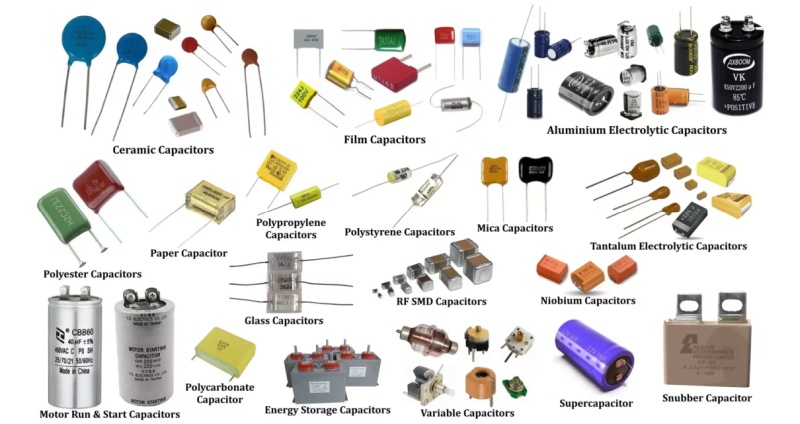 |
| Fig.2, There are at least 1,000 pages on the internet showing us the various types of capacitors. Here is a photo copied from hackatronic.com |
Therefore, we will not devote ourselves to rewriting page 1,001 on the types of capacitors.
As already see there are dozens and dozens of types of capacitors, but there are two main construction solutions: wound-type and laminated-type (stacked)..
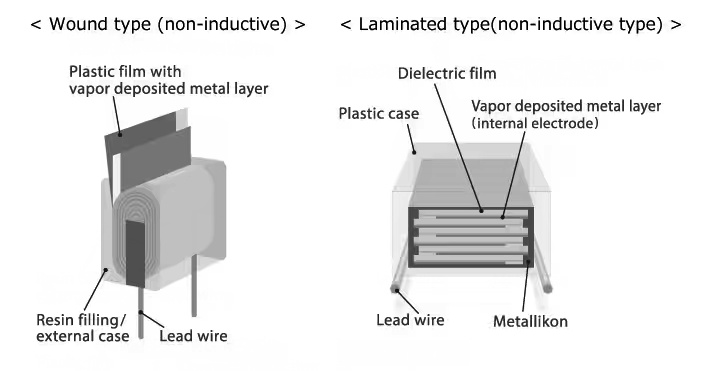 |
| Fig.24, The capacitor on the lesft, which is wound, has one electrode starting from the centre and one from the outside, whereas the capacitor on the right, which is stacked, does not have a structure whereby one electrode is "external" |
In polarised electrolytic capacitors, the outer foil is easy to find if the metal case is connected to the negative pole (in all axial capacitors and similar one). If the case is insulated, there is little to check as the polarity must be respected.
Finding the outer foil is easy if you can trigger a interference on the capacitor and measure the noise captured by the capacitor itself with a sensitive oscilloscope.
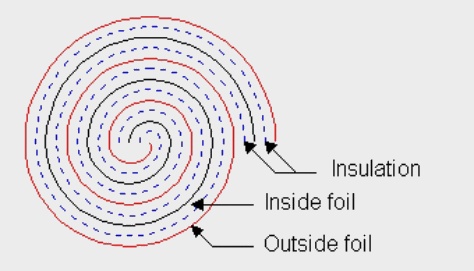 |
| Fig.25, thanks to Lousville University we can read a simple lesson, the ECE220: Lesson 7, Inductors and Capacitors |
We need to know the outer file in order to connect this side of the capacitor to ground or, in any case, to the lowest potential, closest to ground.
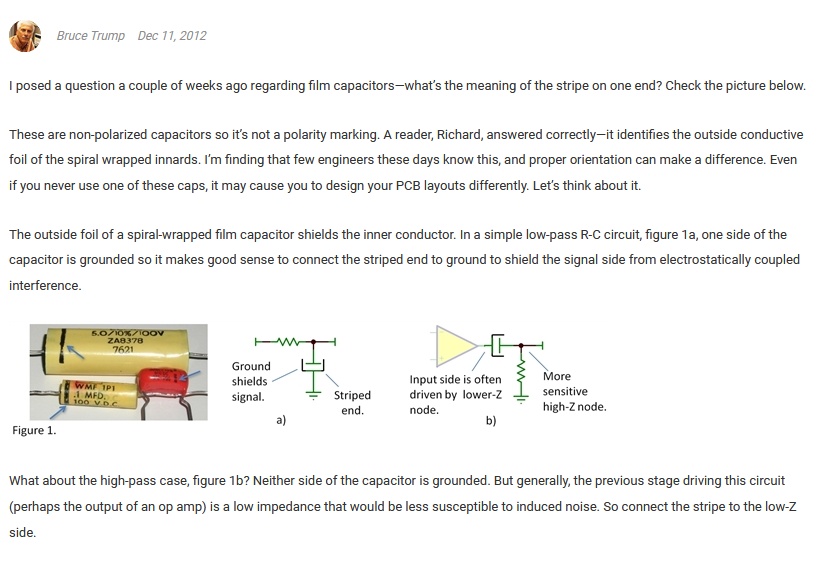 |
| Fig.26, a very simple description of why we need to know how non-polarised capacitors are wound, and knowing how to connect them. Thank you, Bruce |
Now that we have established the need for the measurement, we need to find a reproducible and usable method for typical crossover values. Although there are probably hundreds of references and measurement methods on the internet, we need one that can be replicated.
Watching hundreds of videos on the internet makes it seem very easy. But when you try it yourself, you start to suspect that many of these videos are fake and that they are using tricks (as usual) to attract likes.
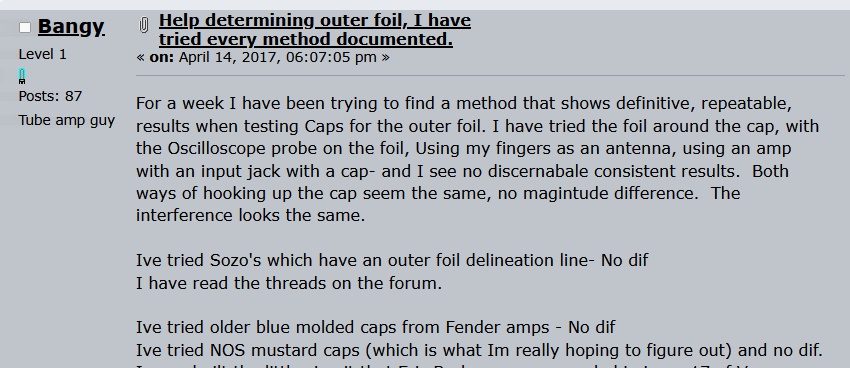 |
| Fig.27, fortunately, someone who has tried many methods says that it is difficult. Thank you, Bangy |
There are also other voices that have doubts about the measure, which seems so easy and simple, as in this other forum: Some findings on capacitor outer foil.
Here.
Here.
Measure method n.3, Capacitance
Here.
Here.
There are many methods available on the internet, all of which use a generator (fingers?) and a measuring instrument (oscilloscope?). Here, for example, is an article by Eric Barbour, How to determine the outer foil of a film capacitor, Vaccum Tube Valley magazine, no. 17, 2001.
Here.
Measure a lot fo capacitor.
Unfortunately, ugly, ugly implications
Here.

| In the last years at Universita' Degli Studi di Roma La Sapienza |
Dr. G. Visco already contract professor for Chemistry in Environment & Cultural Heritage into ---------> |
Laurea Degree Course of Sciences Applied to Cultural Heritage for Diagnostic and for Conservation |


